RPSC RAS Salary 2026: Pay Scale, In-Hand & Job Profile After Selection
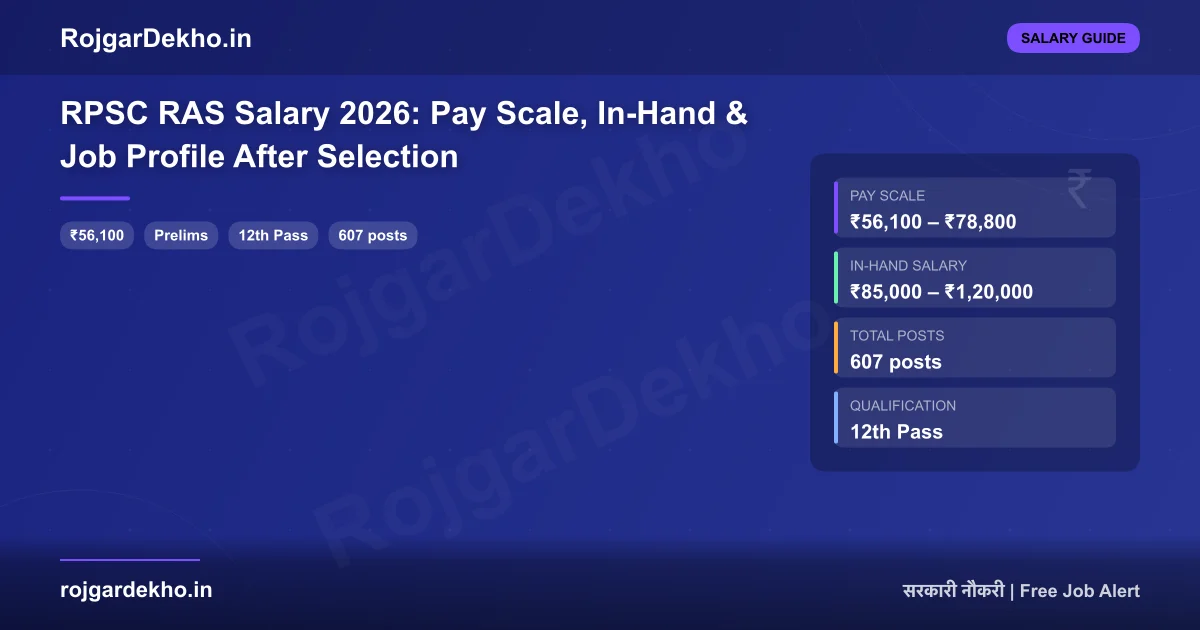
- 607 posts — 192 State Services (RAS) + 415 Subordinate Services
- Entry basic pay: ₹56,100–₹78,800 as per Rajasthan 7th Pay Commission
- In-hand salary: ₹85,000–₹1,20,000/month depending on post and city
By RojgarDekho Team | Updated: June 2026
Before you spend months preparing for RPSC RAS 2026, you need to know what's waiting on the other side. Not the vague "government job stability" answer — the actual number that hits your account every month. This article breaks down the complete RAS salary structure, post-wise pay, allowances, and what your career trajectory looks like.
RPSC RAS Pre 2026 last date: 3 July 2026. Prelims: 29 November 2026. Apply via SSO Rajasthan →
RPSC RAS 2026 — Post-Wise Salary (Pay Matrix)
RAS is a combined examination. Your salary depends entirely on which post you're allocated after the final merit list. The 607 vacancies span two broad categories — State Services (RAS cadre) and Subordinate Services. Here's the pay breakdown as per Rajasthan 7th Pay Commission:
| Post | Service Category | Pay Level (Rajasthan Matrix) | Basic Pay (Entry) |
|---|---|---|---|
| Sub Divisional Magistrate (SDM) | State Services (RAS) | Level 12 | ₹78,800 |
| Deputy Superintendent of Police (DSP) | State Services (RAS) | Level 12 | ₹78,800 |
| Block Development Officer (BDO) | State Services (RAS) | Level 11 | ₹67,700 |
| Tehsildar | Subordinate Services | Level 10 | ₹56,100 |
| Naib Tehsildar | Subordinate Services | Level 9 | ₹53,100 |
| Assistant Engineer (Civil/Mech) | Subordinate Services | Level 10 | ₹56,100 |
| District Revenue Accountant | Subordinate Services | Level 9 | ₹53,100 |
Pay levels above are based on Rajasthan Finance Department notifications (7th Pay Commission implementation). Exact post allocation depends on your rank in the final merit list and vacancy availability by cadre.
Getting into RAS cadre (192 posts) means faster IAS-equivalent promotions and a career ceiling at Commissioner/Secretary level. Subordinate Service posts (415) also carry gazetted officer status but promotion ladders are slower.
Allowances — What Gets Added to Basic Pay
The basic pay is just the starting point. RAS officers receive several allowances on top — here's the actual calculation for an SDM posted at a state-capital city (Jaipur/Jodhpur/Kota):
| Allowance | Rate | Amount (on ₹78,800 basic) |
|---|---|---|
| Dearness Allowance (DA) | 55% of basic (2026 estimate) | ₹43,340 |
| House Rent Allowance (HRA) | 16% (X city) / 8% (Y city) | ₹12,608 / ₹6,304 |
| Transport Allowance (TA) | Level 12 → ₹5,000 + DA | ~₹7,750 |
| Medical Allowance | Fixed ₹1,000/month | ₹1,000 |
| Other state allowances | Varies by post | ₹1,500–₹3,000 |
Dearness Allowance is revised twice a year (January and July) by the Rajasthan government. The 55% figure is an estimate for mid-2026 based on Central DA revision trends — the actual rate may differ slightly.
In-Hand Salary After Deductions
Your gross pay isn't what you take home. Two main deductions apply:
| Post | Gross Pay (approx) | NPS (10% of basic+DA) | Income Tax | In-Hand (approx) |
|---|---|---|---|---|
| SDM / DSP (Level 12) | ₹1,43,498 | ₹12,221 | ₹8,000–₹12,000 | ₹1,10,000–₹1,20,000 |
| BDO (Level 11) | ₹1,13,935 | ₹9,957 | ₹6,000–₹8,000 | ₹92,000–₹98,000 |
| Tehsildar (Level 10) | ₹1,02,888 | ₹8,646 | ₹5,000–₹7,000 | ₹84,000–₹90,000 |
| Naib Tehsildar (Level 9) | ₹98,205 | ₹7,979 | ₹4,000–₹6,000 | ₹80,000–₹85,000 |
NPS deduction: 10% of (Basic + DA) from your side, with 14% employer contribution. The NPS corpus builds up over your service period and pays out on retirement.
Benefits Beyond Salary
The salary number above doesn't capture the full financial picture of an RAS officer's life:
| Benefit | Details |
|---|---|
| Government Accommodation | Type III/IV quarters in most postings — saves ₹15,000–₹40,000/month in rent |
| Medical Coverage | RGHS (Rajasthan Government Health Scheme) — cashless treatment for self and family at empanelled hospitals |
| Leave Travel Concession (LTC) | Travel allowance for home and family travel — once every 4 years (All India) |
| Children Education Allowance | ₹2,250/month per child (max 2 children) for school-age children |
| Telephone/Internet | Reimbursement for official telephone usage |
| Study Leave | Paid study leave for higher education (LLM, IAS preparation) — rare but available |
Salary Growth — How Pay Increases Over a Career
If you clear RPSC RAS 2026 at age 25, here's what your trajectory looks like. Annual increments are 3% of basic pay:
| Year | Age (approx) | Designation (RAS Cadre) | Basic Pay (approx) | In-Hand (approx) |
|---|---|---|---|---|
| Year 1 | 25 | Tehsildar / Naib Tehsildar | ₹56,100 | ₹85,000 |
| Year 5 | 30 | Senior Tehsildar / SDM | ₹65,000+ | ₹1,00,000+ |
| Year 10 | 35 | SDM / Sub-Collector | ₹78,800+ | ₹1,20,000+ |
| Year 20 | 45 | Additional Collector / Deputy Secretary | ₹1,23,100+ | ₹1,80,000+ |
| Year 30 | 55 | District Collector / Secretary | ₹1,44,200+ | ₹2,20,000+ |
RAS officers in the State Services cadre can be empanelled for IAS after 8–10 years of distinguished service. If empanelled, their pay and career trajectory merges with the IAS cadre — the highest administrative service in India.
RPSC RAS vs Other State Services — Honest Comparison
| Service | Entry Pay (approx) | Growth Ceiling | IAS Empanelment | Overall Prestige |
|---|---|---|---|---|
| RPSC RAS (State Services) | ₹78,800 | Secretary/Commissioner | Yes (after 8–10 yrs) | ★★★★★ |
| Rajasthan Police Service (RPS) | ₹78,800 | DIG/IG level | Yes (to IPS) | ★★★★ |
| Rajasthan Finance Service | ₹67,700 | Principal Secretary | No | ★★★ |
| RSSB Subordinate posts | ₹21,700–₹34,800 | Department Head | No | ★★ |
Frequently Asked Questions
Q: What is the in-hand salary for a Tehsildar selected through RPSC RAS 2026?
A Tehsildar at Level 10 (basic ₹56,100) earns approximately ₹84,000–₹90,000 in-hand per month after DA, HRA, TA, NPS deduction, and income tax. This varies based on city of posting.
Q: Do RAS officers get a pension?
Officers recruited after 2004 are covered under the National Pension System (NPS) — not the old defined-benefit pension. You contribute 10% of basic+DA; the government contributes 14%. The corpus is paid on retirement. It's different from the old pension, but the government NPS corpus is significant given 30+ years of service.
Q: What is the difference in salary between RAS cadre and Subordinate Service posts?
RAS cadre posts (SDM, DSP, BDO) carry Pay Level 11–12 entry, while most Subordinate Service posts start at Level 9–10. The difference in basic pay is ₹10,000–₹25,000, and this compounds significantly over a career due to increments and DA.
Q: Is government accommodation guaranteed for RAS officers?
Not guaranteed, but Type III/IV government quarters are available at most district and sub-division postings. Availability depends on the post location. In major cities (Jaipur, Jodhpur), quarters may be occupied — HRA compensates in such cases.
Q: When does the salary increase after joining?
Annual increment of 3% on basic pay is added every year on 1 July. Additionally, promotions bring you to a higher pay level, causing a bigger jump. The first promotion typically happens within 5–8 years based on DPC (Departmental Promotion Committee) recommendations.
Q: How much does an RAS officer earn after 10 years?
After 10 years of service with annual increments and one promotion, a Tehsildar-level officer would be drawing basic pay of approximately ₹75,000–₹85,000, with in-hand salary crossing ₹1,10,000–₹1,20,000/month.
Probation Period — What the First Year Looks Like
If you clear RPSC RAS 2026, you will serve a probation period of typically 2 years before confirmation. During probation, you attend the Rajasthan Administrative Service Training at the Rajasthan Institute of Public Administration (RIPA) in Jaipur. The training covers revenue law, Rajasthan Land Revenue Act, criminal procedure, district administration, and soft skills. During this period, your salary is the regular pay scale — not a training stipend. You're a confirmed gazetted officer from day one of joining.
After probation, you're posted to a district. Your first field posting is typically as a Naib Tehsildar or Tehsildar, managing revenue records, land disputes, and public grievances at the sub-district level. This is where the "power" of the post becomes real — you're the first point of contact for citizens in official matters.
RIPA (Rajasthan Institute of Public Administration) in Jaipur conducts the foundational training for all RAS selectees. The training curriculum includes revenue law, administrative procedures, and departmental examinations.
How City of Posting Changes Your Actual Income
HRA is the biggest variable in your take-home. The difference between a Jaipur posting (X city, 24% HRA) and a rural district posting (Y city, 8% HRA) can mean ₹8,000–₹12,000 per month. Here's the impact on total in-hand salary for a Tehsildar (Level 10, basic ₹56,100):
| Posting Type | HRA Rate | HRA Amount | Approx In-Hand |
|---|---|---|---|
| State capital / Metro (X city) | 24% of basic | ₹13,464/month | ₹90,000–₹95,000 |
| Large city / District HQ (Y city) | 16% of basic | ₹8,976/month | ₹86,000–₹90,000 |
| Small town / Block level (Z city) | 8% of basic | ₹4,488/month | ₹82,000–₹86,000 |
| Government accommodation provided | HRA not applicable | ₹0 | Save ₹15,000–₹30,000 in rent |
If you get government accommodation, you don't receive HRA — but you save substantially on rent. In most district headquarters, government quarters are available and are a major financial benefit that doesn't show up in salary slips.
Annual Increment and How Salary Grows Year by Year
Every year on 1 July, you receive an annual increment of 3% of your basic pay. This compounds. Here's how basic pay grows for a Tehsildar starting at ₹56,100:
| Year | Basic Pay | Annual Increment Added | Cumulative Basic |
|---|---|---|---|
| Year 1 (Joining) | ₹56,100 | — | ₹56,100 |
| Year 2 | ₹57,783 | ₹1,683 | ₹57,783 |
| Year 3 | ₹59,517 | ₹1,734 | ₹59,517 |
| Year 5 | ₹63,147 | ₹1,793 | ₹63,147 |
| Year 8 | ₹69,090 | ₹2,016 | ₹69,090 |
| Year 10 | ₹73,371 | ₹2,091 | ₹73,371 |
Promotion to a higher pay level (from Tehsildar to SDM, for example) involves moving to the next level in the pay matrix. This gives a much bigger jump than annual increments.
RAS vs Private Sector — What You're Actually Choosing
The honest comparison most government job websites won't give you:
| Factor | RAS Officer (Entry) | Private Sector Equivalent (MBA/Engineer, 5 yrs exp) |
|---|---|---|
| Monthly in-hand | ₹85,000–₹95,000 | ₹80,000–₹1,50,000 |
| Job security | Permanent (near-zero dismissal risk) | Layoffs possible anytime |
| Working hours | Office 10–5 officially, but field postings are irregular | Often 9–10 hrs/day |
| Housing benefit | Govt quarters available | No housing benefit |
| Medical benefit | Full family coverage (RGHS) | Group health insurance |
| Pension | NPS (defined contribution) | None / PF only |
| Growth ceiling | Commissioner/Secretary level in Rajasthan govt | Depends on company/role |
| Social status | Very high in Rajasthan (especially rural) | Moderate to high |
The salary numbers are comparable at entry. But the total compensation package — when you include housing, medical, pension contribution, job security, and social status — makes RAS significantly more valuable than the cash salary suggests, especially for candidates from Tier 2/3 cities in Rajasthan.
IAS Empanelment — The Career Ceiling Breaker
This is the part of the RAS career that most preparation websites don't explain: the IAS empanelment option. After 8–10 years of distinguished service in the State Services cadre, RAS officers can be empanelled for the Indian Administrative Service (IAS). This is not guaranteed — it depends on your Annual Confidential Reports (ACR), departmental examinations, and the recommendations of the UPSC selection committee.
If empanelled, your pay and designation merges with the IAS cadre. An IAS officer's pay ranges from ₹56,100 (Junior Scale, entry) to ₹2,50,000 (Cabinet Secretary level). The career ceiling becomes effectively unlimited. RAS officers who get empanelled often serve as District Collectors, Commissioners, and Principal Secretaries.
Real Life of an RAS Officer — What No One Tells You
Beyond the salary, here's what daily life as a Rajasthan Administrative Service officer actually looks like, based on field realities:
The SDM's day: Morning court hearings for land disputes and stay applications. Afternoon field visits — inspecting public works, addressing complaints from gram panchayats, attending collector meetings. Evening paperwork — noting on files, revenue records. The job is demanding but genuinely meaningful. You're the face of the government for citizens in your jurisdiction.
Transfers: Transfers are frequent in the first decade — typically every 2–3 years. This means you'll live across multiple districts of Rajasthan. For someone from a small town, this exposure is career-defining. For someone with family commitments, it requires planning. Your family often relocates with you; government quarters help but aren't always in prime locations.
DSP (Deputy Superintendent of Police) posting: The police track within RAS means criminal investigation, law and order management, and coordination with higher police officials. The work is more irregular (night duties, emergency response), but the authority and social standing are even higher than civil posts at the equivalent level.
Land revenue administration: A significant part of a Tehsildar's or SDM's work is land records — mutations, demarcations, partition proceedings, appeals against revenue orders. Rajasthan's land administration is complex, and this work builds deep domain expertise that becomes valuable in senior postings.
NPS vs Old Pension — Understanding What You're Getting
Every candidate asks about pension. Here's an honest breakdown. Officers recruited after January 2004 (this includes the 2026 batch) are under the National Pension System (NPS) — not the old defined-benefit pension.
Under NPS: you contribute 10% of (Basic + DA) every month. The government contributes 14%. These contributions go into your NPS account, invested in a mix of government securities and equity (you can choose the allocation). On retirement after 60, at least 40% of the corpus must be used to buy an annuity (monthly pension), and the remaining 60% is tax-free as a lump sum.
Example: Starting at basic ₹56,100 and contributing for 30 years, assuming a conservative 8% return, your NPS corpus at retirement could be ₹1.5–₹2 crore. The annuity on ₹80 lakh (40% of ₹2 crore) at 6% rate would give you approximately ₹40,000/month as pension, indexed to inflation thereafter.
Is this worse than the old pension? In pure numbers — the old pension gave 50% of last basic (which for a 30-year service officer could be ₹1,00,000+/month). NPS gives a market-linked corpus. The comparison depends on market returns. But the total NPS corpus at retirement is significant and provides financial security.